
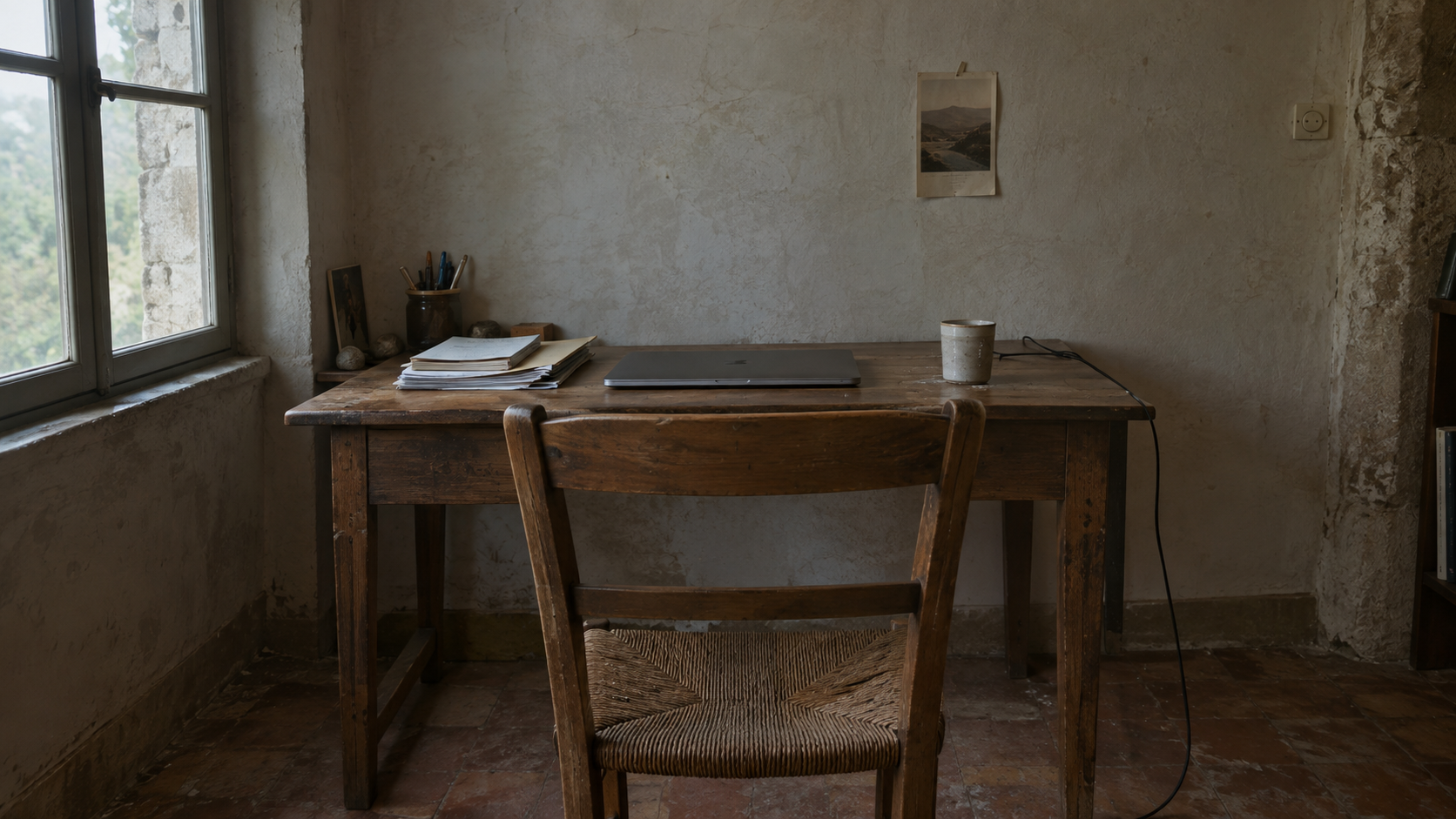
Workplace layout explains what workload does not: for an identical workload, two offices do not drain you in the same way. We put the gap down to the assignments, the colleagues, the time of year. Sometimes it comes down to the room itself.
A tiredness that is not the work’s
There is an end-of-day tiredness that bears no relation to what you produced. You got little done, there was no conflict, the day was unremarkable, and yet you leave hollowed out. Conversely, you can go through a dense day in a room that suits you and come out tired but intact.
The difference rarely lies in the content of the work. It lies in what the place demanded on top of the work: a permanent vigilance, a discomfort compensated for all day, an attention constantly recovered. None of this appears anywhere. It is paid for all the same.
Back to the door
This is the most common arrangement, and the most costly. Sitting with your back to the entrance of a room forces the body to hold a background watch: someone may come in, and you will not see them coming. That watch is never articulated; it is not felt as anxiety. It simply consumes a share of the available attention, all day long.
Turning a desk so the door falls within the field of view, even peripherally, even at an angle, is the adjustment that yields the most effect for the least effort. Those who have done it rarely describe a dramatic improvement. They describe something quieter: they startle less, and return to work faster after an interruption.
The same logic applies to what is behind you. A solid wall at your back provides support. A glazed bay, a walkway, an open corridor provide none.
The light you put up with
A desk facing a window places the eye in permanent backlight, forced to arbitrate between a dark screen and a bright outside. A desk with its back to the window throws reflections onto the screen. In both cases the eye compensates, and it compensates for eight hours.
The right position is almost always lateral: daylight arrives from the side, and the eye has nothing to arbitrate. It is also the only arrangement that lets you enjoy daylight without paying for it. Artificial lighting obeys the same rule: a uniform ceiling fitting flattens a room and tires you; two sources, one general and one set near the work surface, make it bearable.
The noise of other people
Open-plan spaces raise a problem we describe badly. It is not the sound level that costs: it is intelligibility. A conversation whose words you can make out captures attention whether you want it to or not; an indistinct hubbub at the same level does not. It is comprehensible speech, a few metres away, that wears you down.
Hence the failure of most remedies. Lowering voices, adding low partitions, handing out headsets: none of it addresses the cause. What works is separating activities by nature: tasks requiring continuity cannot share a volume with tasks requiring speech. The question is one of zoning, not acoustics.
The rooms where decisions are made
A meeting room with no daylight, no horizon, and proportions either too low or too long produces shorter meetings and blunter decisions. The body wants out, and it speeds up. The haste is then attributed to the agenda.
For places open to the public the stake is different but parallel: reception is settled in the first few metres. A visitor who does not immediately understand where to go stays tense for the remainder of their visit, whatever the quality of what follows.
What a workplace ought to make possible
A workplace that is right goes unnoticed. It is distinguished by neither its furniture nor its style: you recognise it by what it allows. Concentrating without a struggle. Talking without disturbing. Stopping without having to leave the building.
That last point is the one most often missing. Most workplaces offer nowhere to stop for five minutes without being seen or approached. The only available refuge is then the car, or the street. It is a reliable indicator: when people go outside to settle, the building is not letting them.
Analysing a workplace as a system (where the desks sit, light, circulation, zones for concentration and zones for exchange) is part of my harmonisation work, just as much as the home. The useful corrections there are often lighter than one imagines.
Yannick Costechareyre