
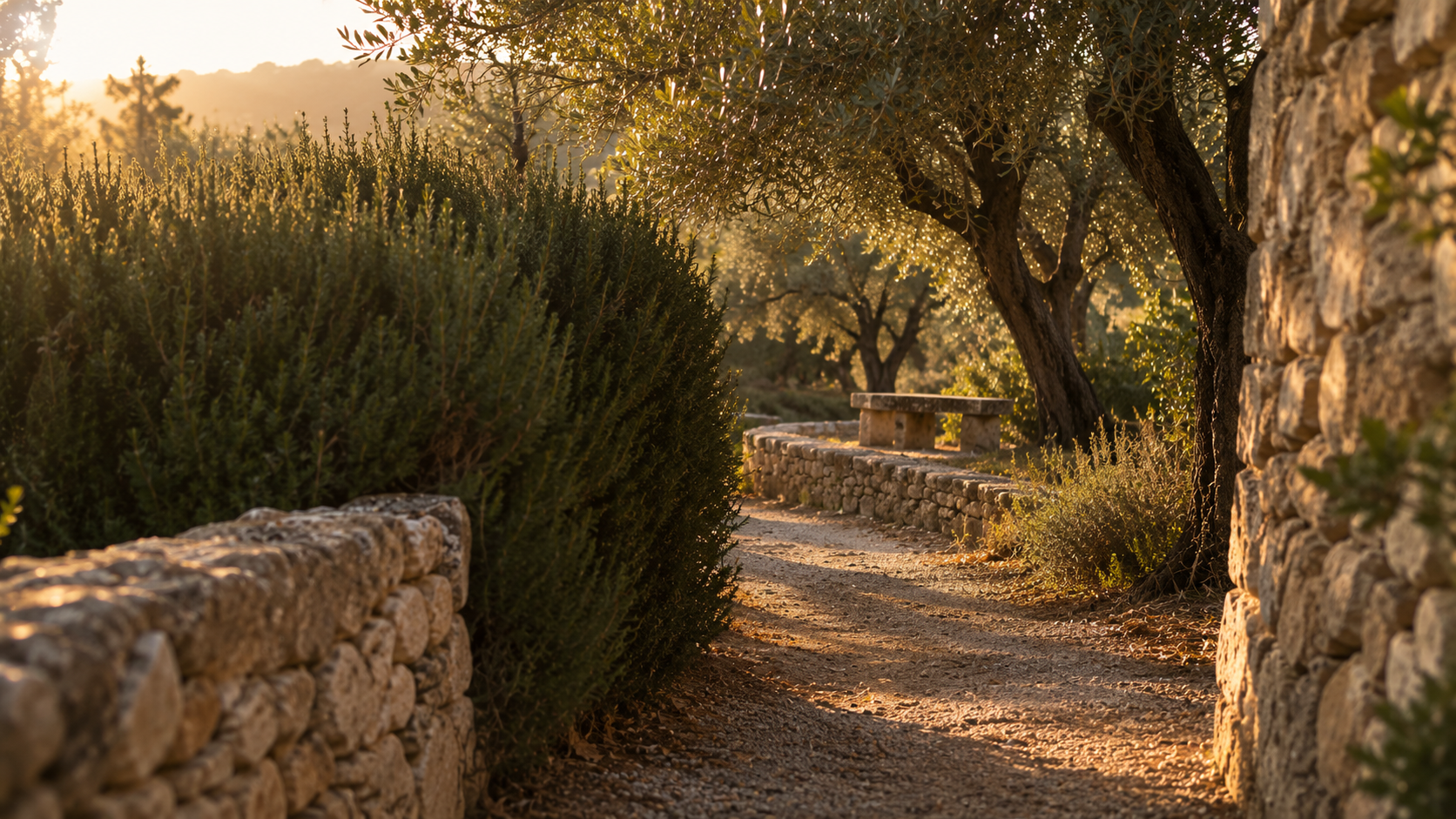
A restorative garden is not designed the way we compose a picture: from the living-room window, head-on, once and for all. But a garden is not looked at. It is walked through, and what you walk through matters more than what you see.
The garden begins before the garden
There is a moment we almost always overlook: the approach. Before entering our home we pass a gate, walk up a path, turn, arrive. That sequence lasts twenty seconds, it repeats twice a day, and it decides the state in which we push the door open.
A garden that reveals itself all at once, entirely, from the entrance, does nothing with that time. A garden that gives itself in fragments (a wall that conceals, a bend, an opening that widens) occupies those twenty seconds. It hands them over to something else. This is not a matter of aesthetics but of rhythm, and rhythm acts on whoever crosses it, whether they notice or not.
Which is why a garden cannot be conceived independently of the building it surrounds. It is that building’s widened threshold. It either prepares you, or it does not.
What an outdoor space does to the body
The body does not treat an outdoor space as it treats an interior. It releases a vigilance there that it maintains under a ceiling. The light is never twice the same, the air moves, sounds come from a distance. These are conditions you cannot reproduce indoors, however good the fit-out.
But that release is not automatic. An outdoor space can just as easily keep you alert: too open, too exposed to view, too dependent on a wind nobody accounted for, too full of structures needing upkeep. You believe you are resting, and you are supervising. Many well-kept gardens tire their owners, because they demand more than they return.
A path, not a picture
For projects that lend themselves to it, I design something other than a layout: a genuine restorative path, in the spirit of healing gardens. The principle differs from an ornamental garden. The garden is not scenery to contemplate but a sequence taken in a precise order, where each station has a function.
The difference is structural. An ornamental garden is judged from a viewpoint. A path is judged while walking, and exists only in the duration of the journey. Its effect cannot be photographed.
Setting down, then gathering back
What gives a path its effect is an alternation. You cross in turn spaces that invite you to set down what you are carrying (the fatigue, the tension, the day’s preoccupation), and spaces that let you settle and steady yourself. Neither works alone.
A garden that only soothes lulls without restoring. A garden that only stimulates excites without unburdening. It is the passage from one to the other, in a considered order, that produces the return to balance. The aim is not to stimulate: it is to recover a stable footing, one that holds after you have gone back inside.
I usually structure this path around the four elements, each marking two moments: one for setting down, one for steadying. This is not symbolism: it is a compositional grid that guarantees the alternation genuinely exists, and that neither function has been forgotten.
Materials that ask for nothing
A restorative path calls for neither spectacular structures nor rare planting. It calls for simple, durable materials: local stone, gravel, untreated timber, plants that hold without watering once established. No staging, no artifice.
This restraint is not a saving but a condition. A place demanding constant upkeep cannot be a place of rest, because you never stop there without seeing work in waiting. Whatever you install, you will have to carry. Better to install little, and well.
What the ground already offers
Before drawing anything, there is observing to do. Where does the sun arrive in the morning, and where does it withdraw in the evening? Where does the prevailing wind come from, and what already stops it? Which part of the ground is naturally sheltered, and which never will be? Where does the eye carry far, and where does it meet an obstacle?
Most of the answers are already there. A piece of ground always proposes something before anything is imposed on it: a backing, an opening, a hollow. The gardens that work are almost always those that followed the proposal rather than fought it.
Reading the ground in this way (what it offers, what it refuses, what it would allow) is the starting point of my harmonisation work, whether for a private garden, a park, a public space or an establishment open to the public. An initial conversation is usually enough to tell whether such work is warranted.
Yannick Costechareyre