
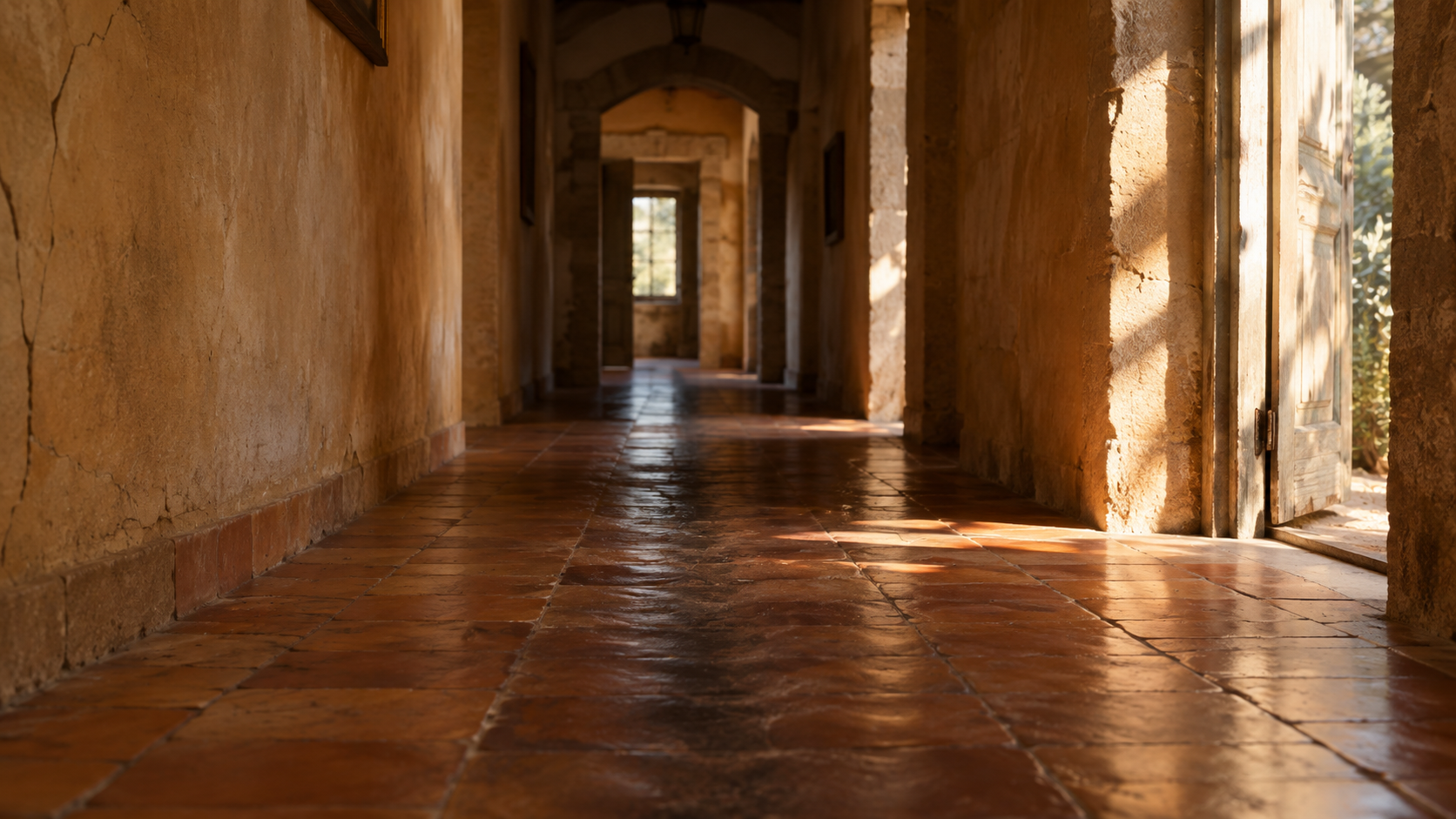
Flow in the home cannot be taken in at a glance: we look at a place the way we look at a photograph, head-on, motionless, from the doorway. But nobody lives in a photograph. We live in movement: the same paths, repeated so often that we have stopped seeing them.
What the floor eventually tells you
In old houses there is a detail almost no one notices on a first visit: the floor is not worn evenly. One strip, often off-centre, is smoother, darker, sometimes slightly hollowed. It runs from the entrance to the kitchen, from the kitchen to the table, from the table to the window. No one drew it. It inscribed itself, under decades of footsteps.
That line is a document. It says where life actually took place, not where it was meant to. The two often fail to coincide. The living room was imagined as the centre of the house; the wear says the centre was the corridor. A fine room at the back was carefully arranged; the floor shows nobody went there.
Recent buildings do not yet carry that memory. But they already carry the movement. A week of observation is enough.
The friction we stop counting
A badly placed path never announces itself as an obvious inconvenience. It announces itself through a minute repetition: the piece of furniture you walk around, the door you must close before you can pass, the bag you always set down in the same spot because there is nowhere else, the three extra steps between the hob and the sink.
Taken alone, none of these gestures weighs anything. It is their number that counts. One unnecessary detour repeated forty times a day makes fifteen thousand detours a year. The body does not protest: adapting is what it does. But adaptation has a cost, and that cost is settled at the end of the day, in a form we rarely attribute to the place: fatigue with no identifiable cause, irritability rising in the evening, a vague sense that something is wrong without being able to say what.
This is one reason we so often look for the cause on the wrong side. We question our sleep, our workload, our relationships. Rarely the route we take thirty times a day.
A place cannot be judged from a floor plan
A plan is read from above, flat, in a single glance. It gives you areas, proportions, openings. It does not give you what matters most: how one moves from one point to another, and what one crosses along the way.
Two homes can have the same floor area, the same rooms, the same orientation, and be lived in radically differently. In one, you go from the bedroom to the bathroom without crossing anything else. In the other, you must cut diagonally through the living room, pass the table, walk around the sofa. On paper the difference is invisible. Day to day it is structural: it decides who crosses whom, at what hour, in what state.
This is why a place is not assessed while standing in the middle of a room. It is assessed by walking it, several times, at the hours when it is actually used.
The points where movement breaks
In almost every place there are two or three spots where movement breaks. The entrance where you stop to put down what you are carrying. The kitchen threshold where two people cannot pass each other. The corner of a corridor that forces a half-turn. The landing too narrow to pause on without being in the way.
These points deserve attention, because they carry most of what we take for untidiness. It is no accident that objects accumulate there: an object set down is almost always an object stopped by a break in circulation. We put things down because we cannot continue.
The reversal is worth holding on to. We believe clutter creates the blockage. More often, the blockage creates the clutter. And as long as the breaking point remains, tidying does not hold: you clear the surface, it fills again within days, and you put that failure down to your own negligence.
What adjusting circulation changes
The good news is that these corrections are rarely heavy. There is no question of taking down walls. Moving a piece of furniture forty centimetres, turning a table around, closing off one door in favour of another, clearing a corner, reversing the way a door swings: the interventions that most change how a place feels are often the least spectacular.
What changes afterwards is no more visible. Gestures become direct again. Objects stop piling up in the same spot, without anyone having had to exercise discipline. Crossings no longer produce their small tension. And there is that impression, hard to put into words, that the place is passed through rather than negotiated.
A place that is right goes unnoticed. That is precisely how you recognise it: it asks for nothing. You stop thinking about it, and attention becomes available for something else.
Looking at your own paths
There is a simple exercise, and it costs nothing. For three days, change nothing, just observe. Where do you slow down? Where do you set down what you are holding? Which piece of furniture do you always walk around on the same side? Which room do you cross without ever stopping in it? Which door stays permanently open, and which stays shut for no reason?
It is not yet a matter of correcting. Correcting too early moves the problem by a metre. It is a matter of seeing first, which is harder than it sounds in a place you know by heart, precisely because you know it by heart. Habit is a comfortable form of blindness.
After three days a drawing appears. It never quite resembles the floor plan. It is from that drawing, and not from the plan, that one has to start.
Understanding how a place is actually crossed is the first stage of my harmonisation work: observing before proposing, and starting from the real situation rather than from a model. Since every place and every situation is different, an initial conversation is usually enough to tell whether an intervention is warranted.
Yannick Costechareyre