
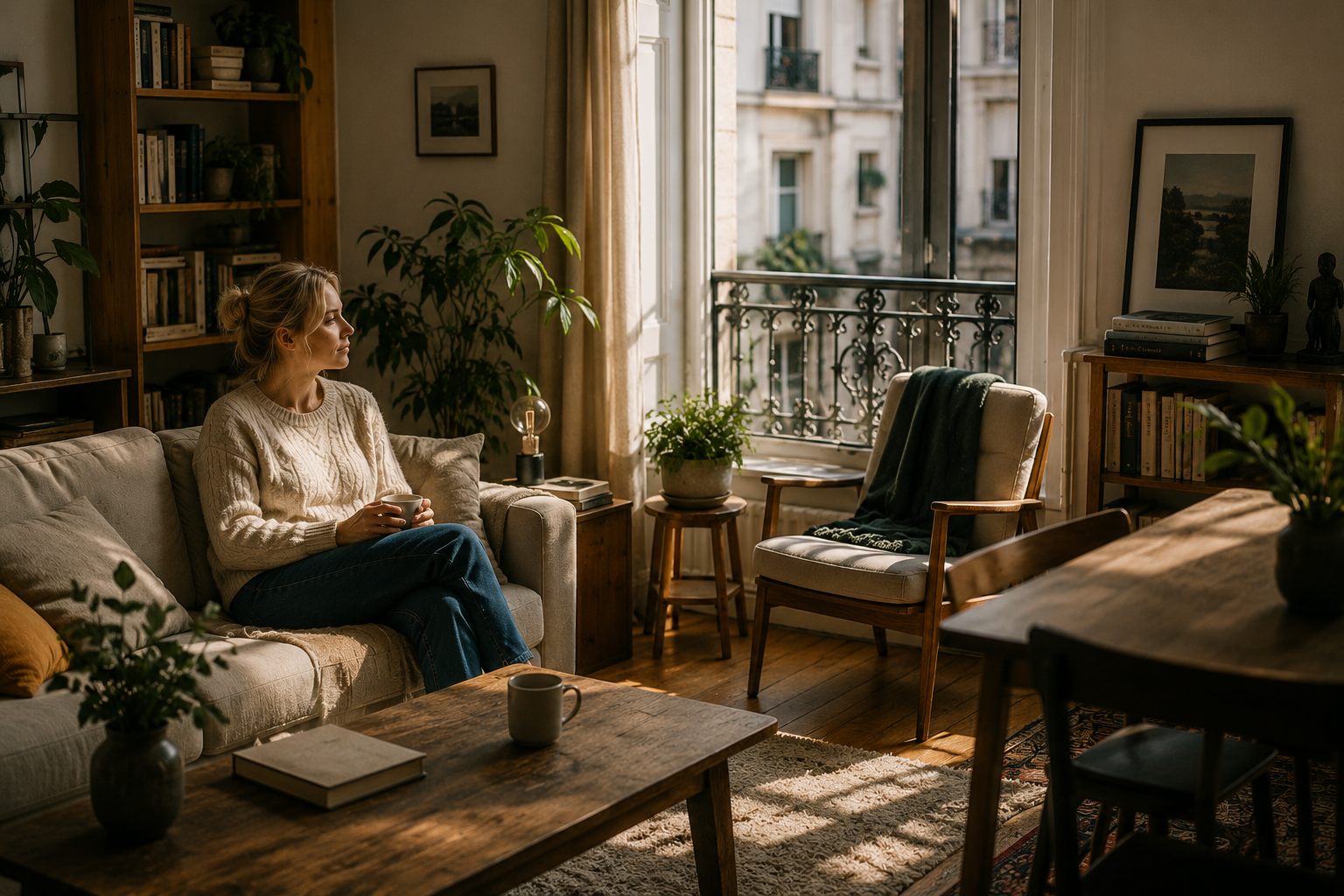
Inhabiting, not merely occupying
We change apartments, move furniture, hang pictures.
And yet it can happen that we live somewhere without truly being there.
Occupying a space and inhabiting it are not the same thing.
Occupying is to be there without being present
One can move through one’s days in a flat the way one moves through a corridor.
The space serves its purpose: it shelters, stores, protects.
But it remains exterior to us. It is a useful relationship, and sometimes that suffices.
Only, something is often missing: the sense of truly being at home.
Inhabiting takes time
In my experience, one does not inhabit a space on the day one puts down one’s bags.
One inhabits it gradually.
Through returning to it, through settling into habits, through leaving traces, a space eventually comes to resemble us. It accumulates memories and familiar gestures.
This is not a matter of style. It is a matter of repeated presence.
Attention, more than decoration
People often believe that a space transforms through buying things.
I believe rather that it transforms first through being looked at.
Taking the time to notice where the light enters in the morning, which corner one avoids, which armchair one always chooses: this is already beginning to inhabit. Attention costs little and changes much.
Simple gestures
To begin, nothing complicated:
- sitting for a few minutes in each room, doing nothing
- noticing what soothes and what bothers
- moving a single thing, and observing the effect it produces within oneself
These are personal observations, not rules. Each person senses their space in their own way, and that is entirely as it should be.
Conclusion
Inhabiting is accepting that a space accompanies us, rather than merely containing us.
It requires neither a budget nor a particular method.
Only a little attention, and a little time.
Yannick Costechareyre