
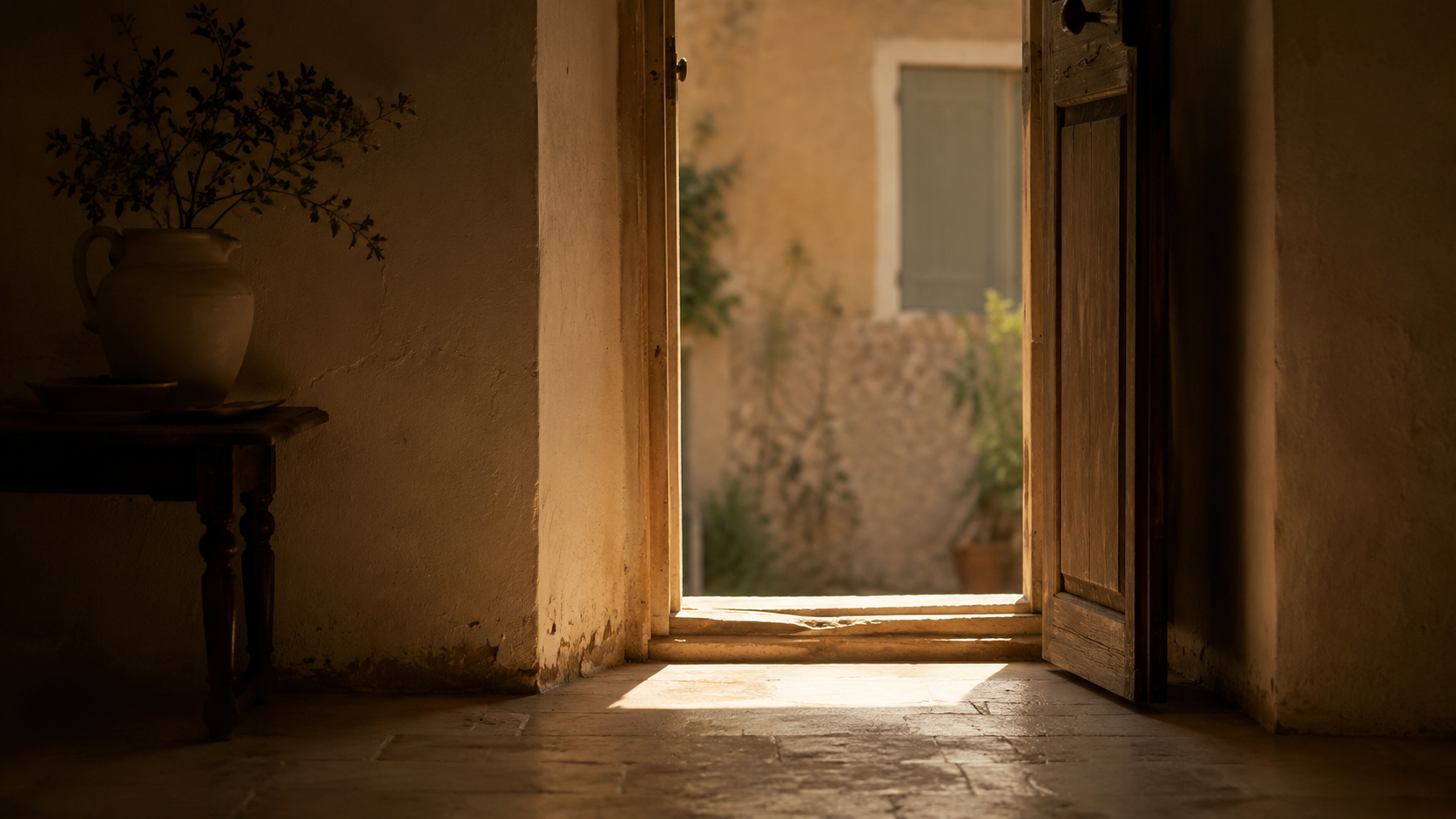
We cross dozens of doors each day without paying attention. Yet every threshold marks a passage: from one space to another, from one state to another, sometimes from oneself to oneself. This most ordinary gesture deserves a pause.
The threshold is one of the oldest elements of human architecture. Long before comfort or ornament, people marked the entrance of their dwellings with a particular sign: a raised stone, a wooden frame, a slight step. As if, in order to enter, one had to perform a small conscious gesture.
A place that is neither quite outside nor quite inside
The threshold belongs to neither of the two spaces it connects. It is no longer the street, not yet the house. This in-between has a precise function: it eases a transition. We set down something of the outside before entering, and take up something of ourselves before leaving.
Old dwellings understood this. The vestibule, the entrance hall, the porch were not wasted spaces but necessary thresholds. There one shed the coat, the dust of the road, the agitation of the outside. One prepared, without knowing it, to dwell differently.
The passage is a time as much as a place
To cross a threshold is also to change one’s inner disposition. We do not enter a home, a place of contemplation, or a place of work in the same way. The body knows it: it slows, straightens, adjusts its step.
Our era tends to erase these passages. Spaces open continuously, boundaries blur, everything communicates with everything. We gain in fluidity what we lose in room to breathe. Yet the mind, like the body, needs these margins in order to settle.
Inhabiting one’s thresholds
To pay attention to thresholds is to relearn how to mark the transitions of our days. It is not only a matter of architecture: it is a way of inhabiting time. To pause a moment before entering, to leave behind what must be left, to welcome fully the place one enters.
A well-designed threshold, or simply a well-lived one, is not an obstacle. It is an invitation to pass from one state to another in awareness. Perhaps this is the true luxury of a place: not what it contains, but the quality of the passage it affords between the world and oneself.
Yannick Costechareyre