
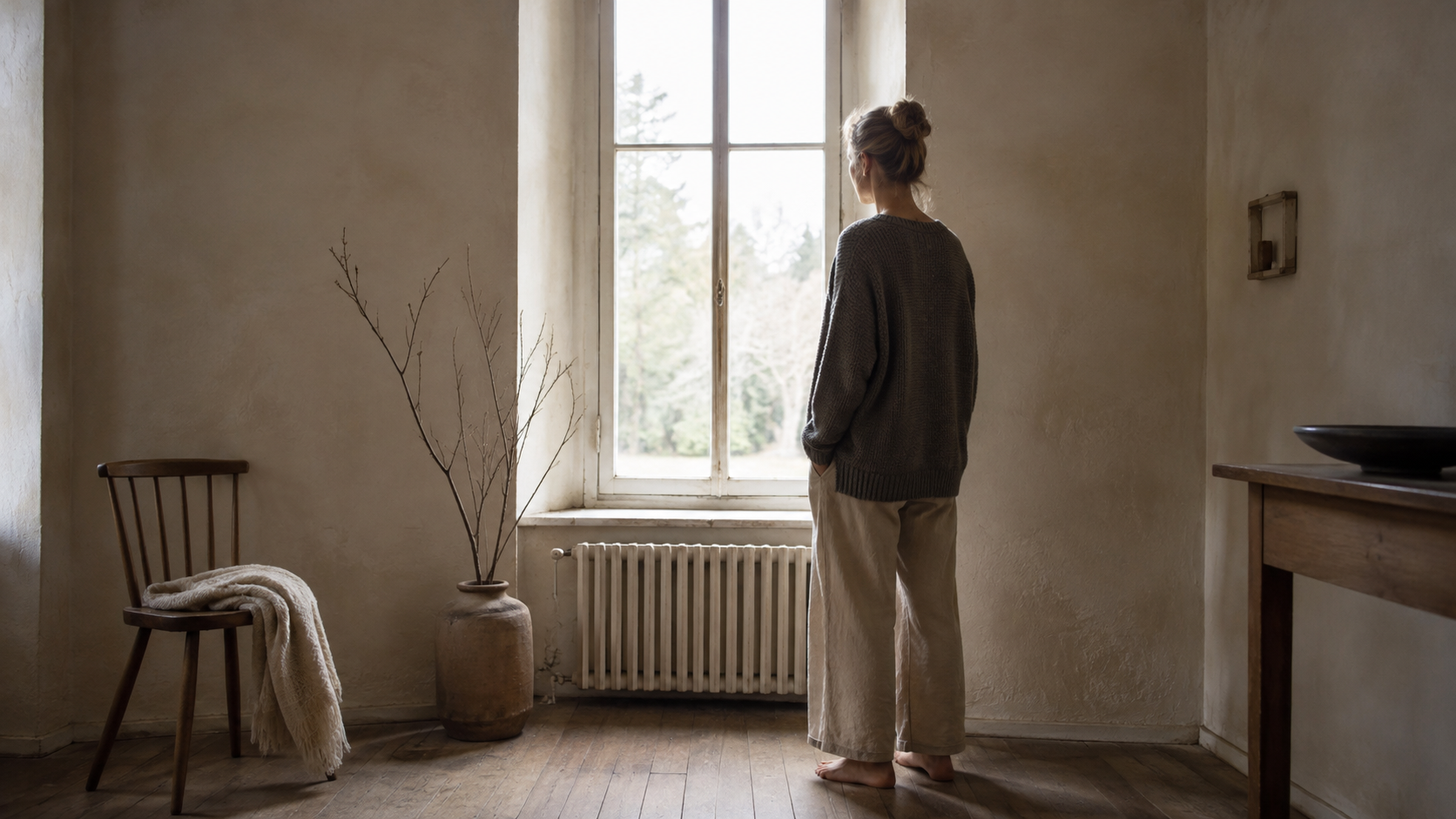
There is a very simple way to look at a place: you walk in, you observe, you judge. It is beautiful, well made, harmonious… on the surface. And yet something may not be quite right. Not necessarily visible, nor explainable. But present.
A silent dialogue
A place is never limited to what it shows. It is run through: by memories, by forms, by tensions sometimes imperceptible. And above all, it enters into resonance with the one who lives in it.
We think we are organising space: choosing objects, composing volumes, creating an atmosphere. But in reality, it is a dialogue: silent and constant. Every element placed in a room acts back: it changes perception, it influences the body, it orients, sometimes without a sound, one’s way of being. An object is never neutral, even the most ordinary one. It carries something: a story, a charge, a continuity. And as long as it is there, it takes part.
What we call clutter
It is not rare to feel that a space is cluttered without knowing why. Everything seems in its place, and yet: a density, a fatigue, an absence of clarity. What we call “clutter” is not only material. It is often a layering of things unseen, unfinished, unreleased.
There is then an almost instinctive movement: to tidy, to sort, to lighten. But this movement, when it is conscious, goes far beyond the act itself. To pick up an object, to pause for a moment, and not to decide immediately, but to feel. What does this stir in me? Not in thought, not in justification, but in the body. Sometimes a simple resistance appears. Sometimes an emotion. Sometimes a kind of emptiness. And it becomes clear that what is held in the hand is not only an object: it is a point of access to something deeper.
Then the gesture changes. It is no longer “I throw away” or “I keep,” but: “does this still have its place within me?” And the answer is not always immediate. Because to let go of an object is sometimes to let go of a part of oneself: a memory, a period, an identity. This is why some spaces remain frozen. Not from lack of will, but because something, deep down, is not ready. The place then becomes the faithful reflection of that state. It does not lie: it shows, with precision.
The place does not only reflect: it acts
But the place does not only reflect. It acts. Forms, for instance, are not neutral: they structure a field. An overly sharp angle can create tension, a beam can generate pressure, a poorly proportioned volume can disturb balance. One could say that each space emits a kind of “signature”: a rhythm. And this rhythm is perceived by the body, even when we do not understand it. Some rooms soothe immediately. Others tire us, for no apparent reason.
Well-being is a coherence
What we call “well-being” in a place is not an abstract notion. It is a coherence: between the forms, the volumes, the materials and the being who lives there. When this coherence is present, something opens: breathing changes, the gaze settles differently, the body relaxes. But when it is absent, even subtly, a friction appears: a slight tension, sometimes barely perceptible, but constant.
Perceiving, rather than knowing
This is where Feng Shui, in its essence, takes on its full meaning. Not as a set of rules, but as a capacity: to read, to feel, to adjust. It is not about knowing. It is about perceiving. Perceiving that an empty space is not necessarily balanced. That a full space is not necessarily alive. That rightness lies neither in fullness nor in emptiness, but in alignment. And this alignment cannot be thought: it can only be felt.
This is why any attempt at standardisation fails. Because each place is unique, and each being is too. What is right for one is not necessarily right for another; what soothes here may disturb elsewhere.
Learning to inhabit
So only one thing remains: to return to a form of simplicity. To enter a place. To pause. To observe. To feel. Without projecting, without correcting immediately, without trying to improve. To let the place speak. And, little by little, something becomes obvious. A shift. A removal. A presence. Simple adjustments, but right ones.
To inhabit a place then becomes something else. It is no longer to occupy a space: it is to live in an environment that takes part, that supports, that accompanies, that reveals. And perhaps, at bottom, Feng Shui is nothing other than this: learning to inhabit. Truly.
Yannick Costechareyre