
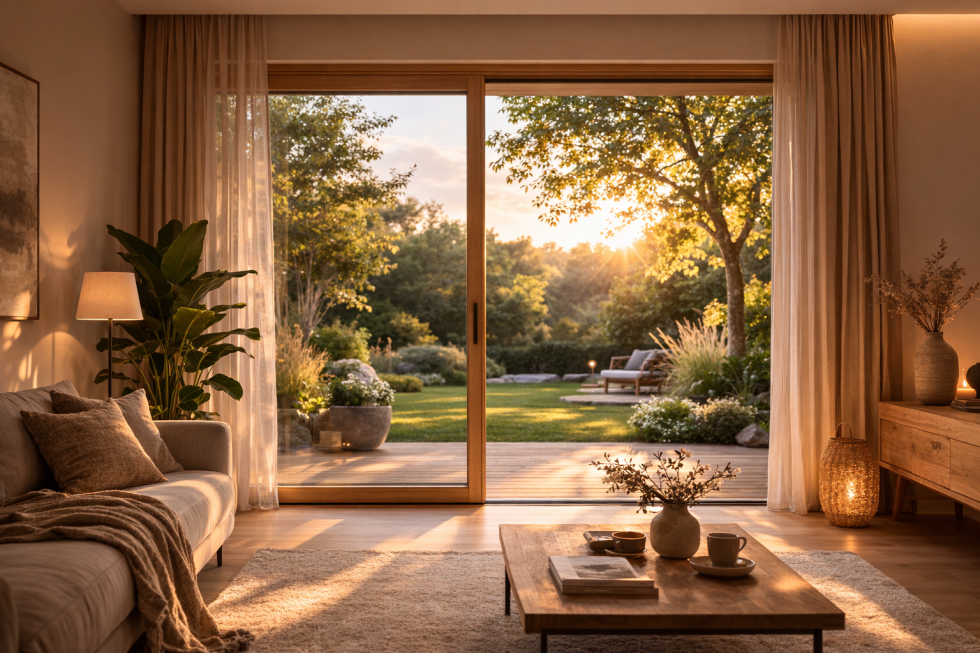
When we think of our home, we often think of a place of rest, protection or comfort. We speak of walls, a roof, space, decoration or arrangement.
But is a home only that?
Since time immemorial, human beings have sensed that habitat is far more than a material construction. It is a space in which inner life unfolds, a place where our relationship with the world takes form.
Our home is not simply a shelter. It is the silent reflection of what we are.
The home as extension of the self
A living space is never limited to its physical dimensions. Every space possesses an atmosphere, its own dynamic, a way of welcoming or repelling.
Some places calm us immediately.
Others tire us without our knowing why.
This reminds us of something essential: spaces profoundly influence our inner state.
Our home becomes far more than a functional space. It becomes an extension of our being.
It reflects our aspirations, our tensions, our dreams and sometimes even our blockages.
Thus, when we inhabit a space, that space inhabits us in return.
The importance of harmony in living spaces
When a home is conceived solely according to material criteria — comfort, aesthetics or financial value — an essential dimension can be missing: inner harmony.
A truly balanced space sustains the life of those who occupy it.
It encourages:
- inner peace
- creativity
- mental clarity
- inspiration.
Conversely, an imbalanced space can accentuate fatigue, confusion or tensions.
This is why, for millennia, different traditions have accorded great importance to the harmonization of living spaces.
Feng Shui in China, Vastu Shastra in India and certain Western traditions have all recognised that habitat influences the quality of our inner life.
Building a space that elevates the being
When we build or arrange a home, we have the opportunity to create something far more than a merely inhabitable space.
We can create a space that sustains our growth.
A space that helps us:
- reconnect with ourselves
- recover inner silence
- nourish our deepest aspirations.
From this perspective, every detail matters: light, orientations, materials, circulation spaces, openings toward nature.
A harmonious space does not simply seek to be beautiful. It seeks to be right.
Right in its relationship to nature.
Right in its relationship to those who inhabit it.
The true home
But beyond the home itself, there is a still deeper truth.
The true home is not located only in the walls that surround us.
It is located first within us.
When our being is coherent, when we cultivate inner peace and clarity of consciousness, we carry with us a form of invisible home.
It is from this inner centre that we can then create truly harmonious living spaces.
For a home is never merely a building.
It becomes a refuge when the consciousness that inhabits it brings:
- presence
- attention
- respect for living systems.
Inhabiting the world differently
Perhaps the true question is not only: how to build a home?
But rather:
how to inhabit the world?
When we begin to look at our living spaces with this consciousness, every space becomes an opportunity.
An opportunity to create more peace.
More beauty.
More harmony.
And perhaps, simply, a place where the human being can remember what they are most deeply.
Yannick Costechareyre