
Since time immemorial, the human being has asked this fundamental question: why is there so much suffering in the world? Why do we go through trials that are sometimes so difficult, sometimes even unjust? And above all, is it genuinely possible to free oneself from them?
These questions have accompanied humanity for millennia. Philosophers, sages and traditions have each tried to answer them, with their own words, visions and experiences. And yet, beyond cultural or religious differences, one common thread emerges: suffering seems to be connected to the way we perceive reality and to the way we perceive ourselves.
Where does suffering come from?
Suffering often appears when we identify entirely with our thoughts, our emotions or the circumstances of our lives. We perceive ourselves as separate, vulnerable beings, dependent upon what happens around us.
When something threatens what we love — a relationship, a situation, a project or even an image we hold of ourselves — fear appears. This fear can take different forms: sadness, anger, frustration, a sense of injustice or abandonment.
Many traditions teach that beyond these emotional layers there exists a deeper dimension of being: a calm, lucid and stable consciousness. When we lose contact with this inner dimension, we tend to feel disoriented, and suffering then becomes a dominant experience.
In this perspective, suffering is not necessarily a punishment. It can be understood as a signal, an invitation to look more deeply within ourselves and to rediscover what, within us, remains intact beyond circumstances.
The meaning of trials
The trials we encounter in life can seem unjust or incomprehensible. And yet they often have the power to transform us.
They sometimes compel us to slow down, to question certain beliefs or to look at our lives from a new angle. What we had considered essential can lose its importance, while deeper dimensions of existence begin to emerge.
In many traditions, difficulties are seen as occasions for learning and growth. They invite us to develop qualities such as patience, compassion, trust or lucidity.
This does not mean that suffering should be sought or glorified. But it can become a passage, a moment of inner transformation that brings us closer to a broader understanding of life.
Reconnecting with our deeper nature
Moving beyond suffering does not necessarily mean eliminating all difficulties from life. It consists rather in transforming our relationship to what we are living.
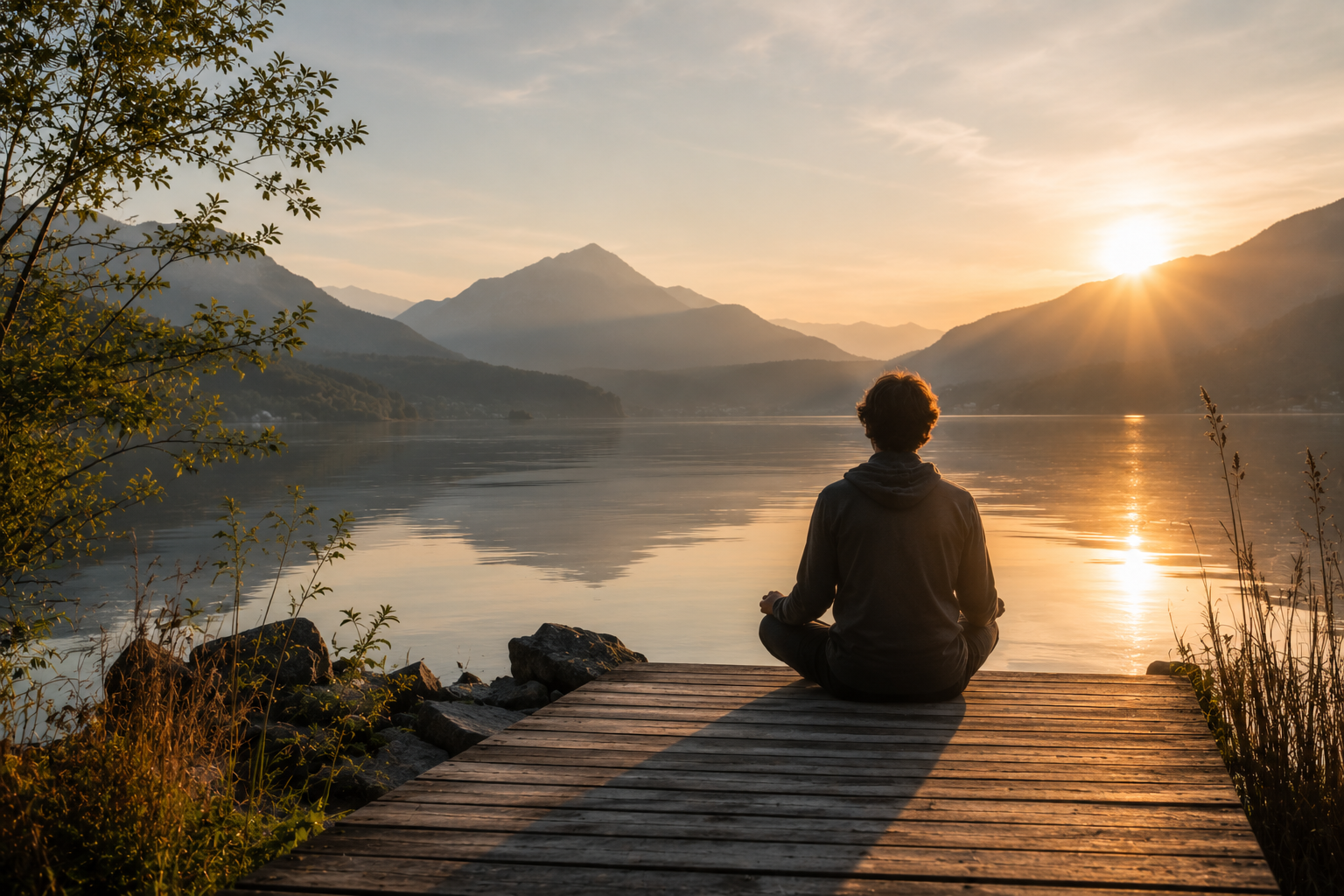
When we take the time to reconnect with our inner dimension — through silence, meditation, contemplation or simply attention to the present moment — something begins to change.
Gradually, we discover that behind the fluctuations of our emotions there exists a space of deeper peace. This space is not a flight from the world, but a different way of inhabiting reality.
By cultivating this inner presence, we become less imprisoned by our automatic reactions. We can observe our thoughts without identifying entirely with them, welcome our emotions without being overwhelmed, and respond to life’s situations with greater clarity.
Transforming our way of living
The transformation of suffering does not pass only through intellectual understanding. It also implies a different way of living.
Acting with kindness, cultivating gratitude, developing listening and presence to oneself and to others are all ways of nurturing a more balanced consciousness.
When we change our way of perceiving and inhabiting life, our relationship with the world also transforms. Difficulties do not always disappear, but they cease to be prisons. They become occasions for growth and inner maturation.
A path of evolution
Suffering is part of human experience, but it is not a definitive fatality.
As consciousness expands, it becomes possible to live with greater peace, lucidity and inner freedom. Each person who engages on this path contributes, in their own way, to transforming the world around them.
Perhaps the true way beyond suffering does not consist in fleeing life, but in learning to live it with a deeper, more open and more enlightened consciousness.
And it is perhaps there that the true transformation begins.
Yannick Costechareyre